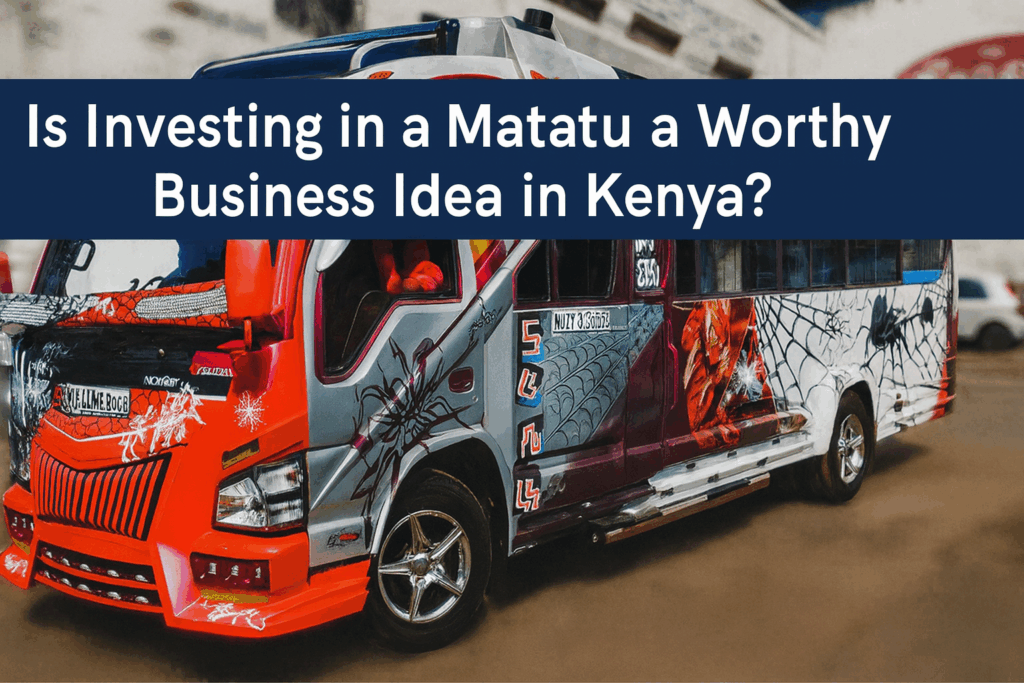
The matatu is one of Kenya’s iconic public transport modes—fiercely competitive, culturally significant, and often controversial. It is a privately owned minibus or van (or sometimes larger bus) that ferries passengers along fixed or semi-fixed routes, often making stops on demand.
Because matatus provide day-to-day cash flows (fares are collected daily), there is a perception among some investors that they offer a kind of quasi-passive income stream: once the vehicle is running and a driver/conductor team is in place, the business “runs itself.” But the reality is more complex.
In this post, I will:
- Outline the capital, regulatory, and operational demands of a matatu business
- Describe the revenue potential and typical cost structure
- Review strategic approaches and sources of competitive advantage
- Highlight the key risks and failure points
- Give a verdict: under what circumstances could it be a “worthy” investment, and when it might not be
- Suggest practical tips for someone seriously considering this venture
By the end, you should have a clearer sense of whether investing in a matatu is likely to be a smart move for you (given your capital, risk tolerance, management skill, and market).
The requirements: capital, regulations, structure
Before you even put a person in the driver’s seat, there are significant barriers to entry. Many of these are well documented in Kenyan media and academic studies.
Capital outlay and sourcing of vehicles
- A new 14-seater matatu can cost up to KSh 3 million or more, depending on make, brand, and modifications.
- Some investors mitigate this by buying second-hand vehicles; for example, one operator bought a used 14-seater for about KSh 580,000.
- If you don’t have full cash available, you may rely on loans. But loans add risk: interest payments, pressure to maintain steady revenue, and possibly being forced to sell in a downturn.
- Beyond the vehicle, there are costs for branding, retrofitting (sound systems, signage, internal fittings), and regular maintenance before deployment.
Hence, your up-front capital requirement is nontrivial. If you are undercapitalized, you may find yourself competing inefficiently from the start.
Regulatory, licensing, and institutional requirements
Even after buying the vehicle, you must navigate several regulatory steps before legally operating:
- You must secure a PSV (Public Service Vehicle) licence and a Road Service License (RSL).
- You also usually need certificates from NTSA (National Transport and Safety Authority).
- You typically must join a Sacco (a recognized matatu cooperative or association) to operate on routes and gain route access. Some Saccos charge KSh 20,000 to 100,000 or more for membership fees, depending on vehicle size, route, and their policies.
- Insurance is mandatory — many operators take only third-party insurance (cheaper but less coverage) because comprehensive insurance can be costly.
- You must contend with enforcement (traffic police, county inspectors), bribes, fines, impounding, and regulatory changes. Many matatu operators view these as recurring “leakages” in revenue.
In short: the “regulatory overhead” is a heavy weight that often slashes margins.
Structural and operational needs
Running a matatu isn’t passive:
- You need to recruit and manage a driver, a conductor, and possibly backup staff. There is a risk of theft, absenteeism, or misreporting. Some sources estimate that 30% of collected revenue is lost to theft, bribes, or internal leakages.
- Maintenance is a constant — oil changes, parts, breakdowns, tires, etc. Some operators mention servicing costs between KSh 4,500 and 5,000 regularly.
- Fuel cost is highly volatile and can swing profitability quickly. When fuel rises, operators usually try to raise fares, but there is a limit to what commuters are willing to absorb.
- Insurance claims – especially with third-party policies – may be rejected, so many operators bear accident costs themselves.
- Competition is fierce; many routes are saturated with operators. This leads to undercutting, fare wars, cutting corners, and lower margins.
- External shocks (fuel price hikes, economic downturns, pandemics) can quickly erode revenues. For instance, during COVID-19, many matatu owners sold off their fleets due to loss of business.
Thus, operational discipline, cost control, and resilience are essential.
Revenue potential, margins, break-even
Given the costs above, what kind of revenue and returns can one realistically expect?
Daily revenue estimates
One operator mentioned earning KSh 2,500 per day on average, with peaks of up to KSh 5,000 during high-demand periods.
But these are gross revenues. After deducting fuel, maintenance, staff wages, insurance, and leakages, the net is much lower.
Another source describes that under current economic pressures, margins have dropped by as much as 75% in some cases. One operator on Nairobi–Murang’a route claimed a 75% drop in profitability.
Cost structure and margin squeeze
Let’s sketch a simplified cost / revenue model (this is illustrative, not guaranteed):
| Item | Approximate Cost / Share of Revenue* |
|---|---|
| Fuel | Could be 20–30% (or more if fuel prices are high) |
| Driver & conductor wages / commission | 10–20% |
| Maintenance, servicing, parts | 5–10% |
| Insurance, licensing, regulatory, sacco fees, route fees, bribes, fines | 5–10% or more |
| Depreciation, capital recovery | Possibly large (especially if loan-financed) |
| Leakages / theft / misreporting / bribes | Possibly 5–10% or more |
* These percentages are indicative; actual values depend on route, distance, condition of vehicle, competition, etc.
Because of the heavy fixed costs (vehicle purchase, major maintenance), the margin is thin. If your route is lightly trafficked, or competition is heavy, you might barely “make ends meet.”
For many matatu operators, it reportedly takes years to break even.
Also, note that vehicles depreciate, and resale may not fully recover your investment, especially if you bought custom modifications.
Load factors, utilization, and scale
To maximize returns, you need:
- High occupancy (i.e. as many seats filled as possible)
- Frequent trips (high utilization)
- Minimal downtime (breakdowns, idling, maintenance)
- Fares sufficient to cover cost + margin
If your route or schedule doesn’t allow full occupancy or frequent loops, your margins will suffer. Volume is critical.
Additionally, many operators prefer diesel engines because of fuel economy and torque (important for loaded vehicles) even though maintenance costs can be higher.
Strategic approaches & competitive advantage
Because the matatu business is crowded and low-margin, success often comes down to how well you compete and differentiate. The academic literature is rich in this regard.
Competitive strategies used by matatu operators
A University of Nairobi study on matatus in Nairobi found that operators deploy multiple strategies to gain competitive advantage. Key strategies include:
- Cost leadership: running lean operations, minimizing costs, reducing wastage, route optimization. This appeals to price-sensitive passengers.
- Differentiation: offering extra comfort, music, smart branding, “luxury” matatus, more reliable schedules, safer travel, cleaner interiors. Some passengers will pay a premium for better service.
- Focus (niche) strategy: targeting particular segments (e.g. specific commuter groups, longer-distance routes, luxury or express service) rather than trying to be all things to all people.
- Unique competencies / internal capabilities: good human resource management, efficient scheduling, strong maintenance systems, trustworthy staff, strong relationships with SACCOs and regulatory bodies.
In fact, in a regression analysis on PSV performance in Nairobi, cost leadership, differentiation, focus, and unique competency variables had positive correlations with performance; these factors collectively explained ~77% of variation in performance.
Also, in the broader “paratransit strategy” literature, one trend is the shift from purely individual matatu ownership toward franchising, networking, and owning multiple vehicles (i.e. scaling) to create efficiencies and bargaining power.
Route selection, scheduling, and flexibility
Route selection is critical. Some routes are saturated. Others are underserved. If you pick a route with less competition but decent demand, you might capture more margin. Express routes with fewer stops, high frequency commuters, or “skip-stop” services are possible differentiators.
Operators must constantly optimize trip scheduling, route deviation, loading and unloading times, and minimize idle time.
Branding, customer experience, and reputation
In the matatu business, reputation matters. Passengers may choose one matatu over another because it’s cleaner, more reliable, safer, or simply has better branding (sound system, visuals). Differentiation helps reduce the “race to the bottom” fare competition.
Some operators invest in nicer interiors, on-time performance, courteous staff, and clean vehicles to justify slightly higher fares.
Also, marketing (word-of-mouth, signage, digital presence) can help in routes with many competing operators.
Technology and innovation
While many matatu operations are still informal, there’s room for smarter systems:
- Digital fare collection, tracking, and oversight can reduce leakages
- GPS and route optimization tools
- Real-time passenger information
- Demand forecasting
- Possibly incorporation of electric vehicles (EVs) or hybrid models in the future
One example relevant to Kenya is BasiGo, a Kenyan electric bus company that leases electric buses to local shuttle operators. The model offers an alternative to traditional diesel matatus and points to emerging trends in public transport electrification.
In sum: the matatu business is not just about owning a van and driving. The edge comes from management capability, differentiation, cost control, and scaling.
Risks, challenges, and failure modes
Even with the best strategies, many matatu ventures fail or underperform. Here are key risks to watch out for.
Overcompetition and market saturation
One of the biggest complaints from industry insiders is that the matatu sector in Kenya is overcrowded. Many routes have too many operators, which drives down fares and margins.
Even a small drop in passenger numbers or fare sensitivity can push an operator from profit to loss.
Volatility in fuel, regulatory, and macro conditions
Fuel price increases, changes in tax policy, new regulatory demands, or enforcement crackdowns are constant threats. In 2023, operators reported that increased fuel prices, license fees, spare parts costs, and more frequent arrests/fines have eroded profits.
An economic downturn or rising unemployment also reduces discretionary travel. Some operators reported profit declines of up to 75 %.
Loan & financing risk
If the matatu was financed via debt, failing to meet repayments can push the business into distress. High interest rates further strain cash flows.
Also, because matatu resale value is uncertain, in a downturn you may struggle to recoup capital by selling the vehicle.
Internal leakages, theft, malfeasance
In some operations, driver or conductor leakage (stealing fares) is a serious problem. One quoted operator claimed as much as 30% of revenue is lost to internal leakages, bribes, or other “informal payments.”
Managing trust, supervision, incentives, and accountability is essential.
Maintenance and breakdowns
Vehicles in Kenya’s traffic, on rough roads, and under heavy load suffer frequent wear and tear. Unexpected breakdowns reduce uptime and eat margins.
If the vehicle is poorly maintained, costs escalate and operations shrink.
Regulatory or policy shocks
Government might introduce stricter regulations, remove certain routes, increase license fees, or enforce compliance in ways that raise costs. There is always risk of policy changes or enforcement intensifications.
Also, environmental or emissions regulation could push the industry toward higher-cost vehicles or electrification mandates.
Exit risk and illiquidity
Selling a matatu (especially one with custom modifications or with wear) may fetch much less than the purchase price. Some investors report that assets depreciate and cannot be sold at a favorable price.
If you need to exit quickly, you might have to accept a loss.
Nonfinancial risks
- Accidents, liability, and reputational damage
- Crime (vandalism, theft)
- Regulatory harassment, impounding, fines
- Poor safety record leading to customer avoidance
- Fuel theft or diversion
Because these risks are multiple and interconnected, the margin for error is small.
Is it a “worthy” business? Conditions for success
Given all that, is investing in a matatu a good idea? The honest answer is: it depends heavily on how well you execute, your capital base, risk appetite, and your operating environment. It is not a “guaranteed win,” but it can be viable under favorable circumstances. Below is a decision framework.
When it could be a good business
You might view it as worthy if:
- You have sufficient capital (ideally cash) to absorb initial losses or delays. If you have to rely heavily on loans, the risk is much higher.
- You can secure a good route — moderate competition, strong demand, commuter flow, minimal empty runs.
- You are operationally disciplined — you manage staff well, control leakages, maintain vehicles rigorously, minimize downtime.
- You differentiate — providing better service (comfort, reliability, safety) so you’re not competing solely on price.
- You can scale — owning multiple vehicles or routes, achieving economies of scale, spreading fixed costs.
- You have a buffer against external shocks — for instance, fuel price hedges, contingency funds, flexible financial structures.
- You keep a close eye on regulatory trends and maintain good relationships with SACCOs, local authorities, and associations.
- You manage exit risk — accept that your asset may depreciate, and have a plan for resale or backup revenue streams.
If you can check many of those boxes, a matatu investment can yield modest returns over time and cash flow. It becomes less of a speculative gamble and more of a business.
When it’s likely to fail / not worth it
You might avoid investing if:
- You are undercapitalized or heavily loan-dependent
- You pick saturated or low-demand routes
- You have weak management capacity or no track record in transport or logistics
- You cannot control leakages, theft, or staff misconduct
- You are overly exposed to fuel cost fluctuations or regulatory changes
- You lack the ability to scale or diversify
- You expect a quick return — matatu ventures often require patience, especially for ROI
In many cases, “outsiders” who dive in without deep stack experience or buffer capital eventually exit with losses, as some seasoned operators advise. “Invest your money in something else,” one industry insider was quoted saying.
Comparative alternatives and opportunity cost
It’s important to consider: what else could you do with the same capital and risk exposure?
- Real estate (e.g. renting shops or apartments) might offer more stability
- Franchises or retail business
- Other commercial transport models (e.g. buses, shuttles, logistic vans)
- Asset leasing (e.g. leasing vehicles to operators rather than operating them)
- Partnerships or equity stakes in existing transport firms
The opportunity cost is high—if you could invest in a lower-risk, higher-return venture, that might dominate.
However, the matatu business offers something unique: daily cash flows, tangible assets, and demand-insulated (people still need to move). So the trade-off is between risk and yield.
Practical tips if you decide to pursue this
If after all this you still believe the matatu business has potential in your hands, here are practical steps and tips:
- Market research & route scouting
- Observe commuter trends, peak flows, gaps in service
- Identify routes with underserved demand or less competition
- Check existing operator behavior, fare levels, and waiting times
- Start lean
- Begin with one vehicle, test the market, refine operations
- Use a second-hand vehicle of good condition if new is prohibitive
- Run strict cost control and monitor every expense
- Form ties with a good SACCO
- Join a SACCO that has strong reputation, route access, regulatory clout
- Negotiate favorable terms and avoid exploitative membership fees
- Build relationships with key stakeholders early
- Recruit trustworthy staff & align incentives
- Hire drivers and conductors with proven reliability
- Use performance-based pay or monitoring systems
- Use technology (GPS, video, digital collection) to reduce leakages
- Maintenance discipline
- Preventive maintenance is cheaper than reactive repairs
- Keep spare parts in stock
- Monitor vehicle health, repair issues early
- Differentiate and brand
- Clean interiors, good sound, comfortable seats
- Reliable schedule adherence
- Safety features, customer service
- Use signage, social media, local marketing
- Flexible pricing & fare adaptation
- Adjust fares when fuel or cost pressures arise, within what customers can bear
- Consider express or premium services on some runs
- Plan for contingencies
- Maintain cash reserves
- Prepare for fuel spikes, regulatory changes
- Diversify route coverage if possible
- Track performance metrics
- Daily revenue, load factor, trip cycles, downtime, maintenance cost per km, leakages
- Use data to iteratively improve
- Exit strategies
- Know resale value trends
- Keep vehicle in decent shape
- Have plan B (e.g. converting to shuttle, school service, tours)
- Consider collaboration or scaling
- Rather than operating solo, partner or expand to multiple vehicles to share overhead
- Franchising or leasing to operators might reduce your operational burden
Conclusion & verdict
So, is investing in a matatu a worthy business in Kenya in 2025? The honest answer is: yes — but only under certain conditions. It is not a guaranteed goldmine, and many fail or operate at razor-thin margins. But with enough capital, operational excellence, route choice, differentiation, and risk management, it can be a stable, cash-generating venture.
If I had to summarize:
- The upsides: steady demand (people must move), tangible assets, potential for scale, possibility of premium service niches
- The downsides: heavy competition, volatility (fuel, regulation), internal leakages, high fixed costs, exit risk
If you’re considering this, you should only proceed if:
- You have enough buffer capital
- You plan to manage it actively, not passively
- You choose your routes wisely
- You differentiate and execute better than average
- You monitor risks closely
Frequently Asked Questions (FAQs) About Investing in a Matatu in Kenya
1. How much capital do I need to start a matatu business in Kenya?
The amount depends on the type of vehicle you want. A brand-new 14-seater matatu can cost around KSh 2.5–3 million, while a decent second-hand vehicle may cost between KSh 600,000 and 1.2 million. Beyond the purchase price, you’ll also need funds for branding, Sacco membership fees, insurance, licenses, and maintenance. A safe estimate is at least KSh 1 million if starting with a used matatu.
2. Is the matatu business profitable in 2025?
Profitability depends on route selection, passenger demand, and management discipline. On a good route, a matatu can generate KSh 2,500–5,000 daily. However, expenses like fuel, wages, Sacco charges, and bribes reduce the net significantly. Rising fuel costs and saturated routes have made profits thinner. Still, with strong management, cost control, and differentiation, the business can deliver modest but steady returns.
3. How long does it take to break even?
Breaking even can take 2–5 years, depending on whether you bought the vehicle on cash or loan. Operators who finance through loans usually take longer because of high interest rates. Consistent utilization, high occupancy, and low maintenance costs are crucial for a faster payback period.
4. What are the biggest risks of running a matatu?
The key risks include:
- Fuel price volatility, which eats into profits.
- Route saturation, leading to fare wars and reduced margins.
- Leakages, where drivers and conductors underreport collections.
- Regulatory changes, which can increase costs overnight.
- Accidents and vehicle breakdowns, leading to downtime and liability.
Managing these risks is essential for long-term survival.
5. Do I need to join a Sacco?
Yes. By law, matatu operators must belong to a Sacco. Saccos regulate routes, organize compliance, and negotiate with authorities. Membership fees range between KSh 20,000–100,000 depending on the Sacco. Choosing a reputable Sacco is critical, as they can either support your operations or become an unnecessary burden if mismanaged.
6. Can I run a matatu as a side hustle?
Yes, but it is not entirely passive. Many investors hire drivers and conductors while they handle oversight. However, this setup risks mismanagement and theft. If you’re a part-time owner, you must have strict controls in place: GPS tracking, daily revenue targets, and strong relationships with staff. Without close supervision, returns may dwindle quickly.
7. What routes are most profitable?
Routes with heavy commuter traffic—such as Nairobi to satellite towns (Thika, Kitengela, Rongai, Kiambu)—tend to be profitable. Long-distance routes like Nairobi–Mombasa or Nairobi–Kisumu can also yield good revenue, but they involve higher maintenance and fuel costs. Profitability varies widely, so thorough route research is essential before investing.
8. Should I buy a new or second-hand matatu?
A new vehicle offers reliability, fewer breakdowns, and better passenger appeal but is capital-intensive. A second-hand matatu is cheaper but may have higher maintenance costs and a shorter lifespan. For first-time investors, a good-quality used vehicle is often a safer starting point.
9. How do I minimize losses in the matatu business?
- Install tracking systems to monitor trips and collections.
- Recruit trusted staff and tie pay to performance.
- Service the vehicle regularly to avoid costly breakdowns.
- Join a reputable Sacco with supportive leadership.
- Consider diversifying routes or owning multiple vehicles for scale.
10. Is investing in a matatu better than real estate or other businesses?
That depends on your goals. Real estate offers stability and long-term appreciation, but matatus provide daily cash flow and quicker liquidity. However, matatus carry higher operational risks and require more active management. If you prefer hands-off, long-term growth, real estate may be better. If you want daily cash flow and are willing to manage risks, a matatu could work.