For decades, the foundation of the Kenyan Dream has been cast in red soil: owning a piece of land, securing the title deed, and passing down a tangible asset to the next generation. The prestige, the control, and the historical appreciation have made direct land ownership the gold standard of investment.
But the 21st century has introduced a formidable, sophisticated, and accessible challenger: Real Estate Investment Trusts (REITs).
REITs allow any Kenyan with as little as a few thousand shillings to own a proportionate share of a billion-shilling mall, a premium student housing complex, or a grade-A office tower in Upper Hill—all without the stress of managing tenants, paying county rates, or conducting a nerve-wracking land search.
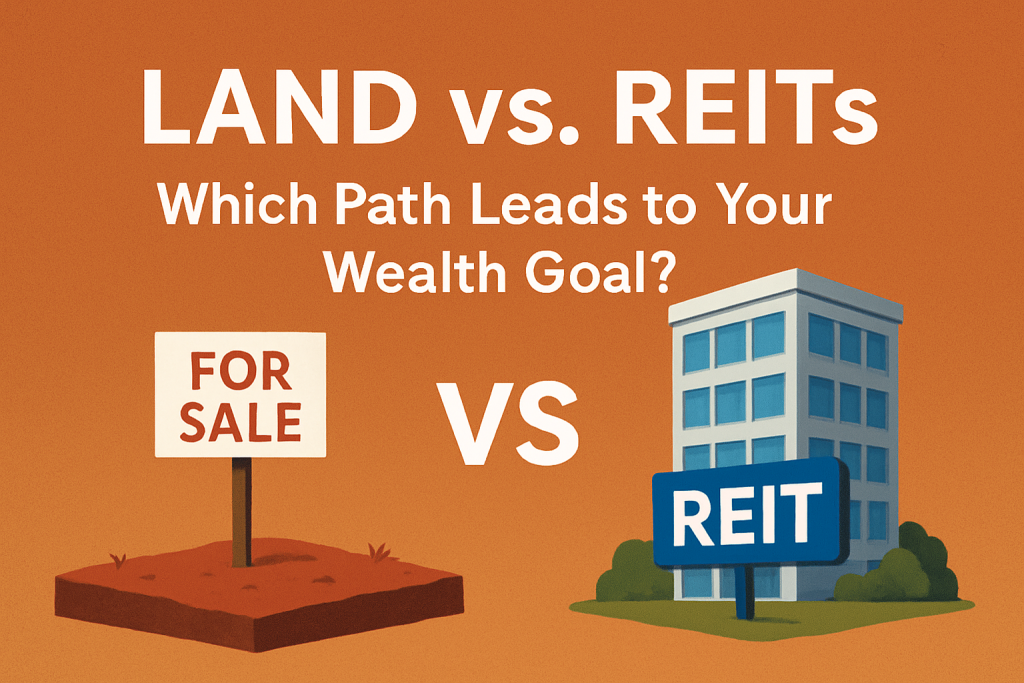
For the modern investor, the question is no longer if they should invest in real estate, but how. This comprehensive guide breaks down the ultimate battle for your capital: Direct Land Ownership vs. Investing in REITs.
Part I: The Old King – Investing in Land 🏡
Direct land ownership, whether through purchasing a plot for shamba or buying an apartment for rental income, is the traditional route to wealth in Kenya.
The Land Investment Proposition: High Control, High Barrier
| Factor | Description |
| Capital Requirement | Very High. Requires millions of shillings for a decent plot in a marketable area (e.g., KES 500,000 for remote plots to KES 5 million+ for a 50×100 plot near Nairobi). |
| Control | Absolute. You decide the location, the use (commercial/residential), the timing of development, and the selling price. |
| Cash Flow | Zero/Negative. Vacant land generates no income. It costs money (rates, fencing, security). Developed property generates rental income. |
| Liquidity | Very Low. Selling land can take months or even years, especially in a slow market, and you cannot sell a fraction of a plot for quick cash. |
| Risk Focus | Fraud, Titling, and Location Risk. All the risk is concentrated in one specific physical asset. |
The Indisputable Benefits of Land
- Tangibility and Heritage (The Emotional Factor): The emotional pull is enormous. You can physically stand on your investment. It is a legacy asset that offers immense social value and security.
- Inflation Hedge: As the Shilling depreciates, the value of well-located land tends to rise. Furthermore, landlords can typically adjust rents upwards to combat inflation.
- Potential for Outsized Returns: Buying a plot in a future growth area (like the path of a new bypass or satellite town) can yield multiples of the initial investment when infrastructure arrives.
- Leverage for Debt: A title deed is the gold standard collateral for securing large loans from banks, enabling further investment or business expansion.
The Crucial Risks and Costs of Land Ownership
The perceived simplicity of land ownership hides numerous financial and administrative burdens that often surprise first-time investors:
A. Hidden Costs of Acquisition
The purchase price is just the beginning. You must account for:
- Legal Fees: Typically 1% to 2% of the land value.
- Stamp Duty: 4% of the property’s value for urban land and 2% for rural land. This is a non-negotiable tax.
- Valuation Fees: Required for bank financing and stamp duty assessment.
- Land Rates & Rent Clearance: Must be cleared before the transaction can proceed.
- Land Control Board (LCB) Fees: Required for consent to transfer agricultural land.
B. The Threat of Fraud and Titling Risk
This is the single biggest threat in the Kenyan real estate sector.
- Fake Title Deeds: Fraudsters impersonate owners or forge documents, selling the same land multiple times.
- Boundary Disputes: Poorly surveyed land leads to costly legal battles with neighbours.
- Squatters/Encumbrances: Buying land with existing claims (family, community, or squatters) that can render the plot unusable until the case is settled in court.
C. The Burden of Dead Capital
A multi-million shilling plot of vacant land is dead capital. It does not generate income. In fact, it requires constant maintenance, including:
- Fencing and Security to ward off encroachers.
- Annual county land rates payments.
Part II: The New Guard – Real Estate Investment Trusts (REITs) 📈
REITs are collective investment schemes that pool money from many investors to acquire, develop, or hold a portfolio of income-producing real estate assets. Think of them as the stock market equivalent of a landlord. When you buy a unit (share) in a REIT, you become a fractional owner of a massive, professionally managed property portfolio.
The REIT Proposition: Low Barrier, High Liquidity
| Factor | Description |
| Capital Requirement | Very Low. You can buy units with as little as KES 1,000 to KES 5,000, making investment instantly accessible to the average Kenyan. |
| Control | Zero. Investment decisions are made by a professional REIT Manager and overseen by an independent Trustee. |
| Cash Flow | High and Consistent. I-REITs (Income REITs) are legally required to distribute at least 80% of their net income as dividends. |
| Liquidity | Very High. Units are bought and sold on the Nairobi Securities Exchange (NSE) or the Unquoted Securities Platform (USP). You can exit your investment in days. |
| Risk Focus | Market Risk and Management Risk. Risk is diversified across multiple properties and sectors. |
The Two Main Types of Kenyan REITs
Understanding the two types is crucial for aligning the investment with your financial goals:
| Type | Goal | Focus | Typical Kenyan Example |
| 1. Income REIT (I-REIT) | Generate Passive Income. | Owns finished properties (student housing, malls, offices) that generate immediate rental income. | ILAM Fahari I-REIT, Acorn ASA I-REIT |
| 2. Development REIT (D-REIT) | Capital Growth. | Pools funds to develop new properties from scratch. Income is delayed until the development is sold or leased. | Acorn ASA D-REIT |
Conclusion: The Modern Kenyan Investor Diversifies
The most successful investors in the world—and in Kenya—rarely choose one asset class over another; they build a strategy where different investments play different roles.
The choice between Land and REITs is not about which one is better, but which one aligns with your current financial need:
- If your goal is creating a lasting family heritage, having absolute control, and using the asset as loan collateral: Land is the necessary foundation. Just ensure you commit to extreme due diligence to mitigate the crippling risks of fraud and concentrate on land with immediate development potential, not just land banking for decades.
- If your goal is immediate passive income, low-risk exposure to prime real estate, liquidity, and maximizing post-tax returns: REITs are the clear winner. They are the vehicle of choice for the young, the middle-class professional, and the retired individual seeking a consistent income stream without management stress.
The Hybrid Strategy: The smartest approach is to embrace both. Use a small, accessible portion of your capital to start building a diversified, income-generating portfolio through REITs. This liquid cash flow can then be strategically used to fund the development of your long-term land holdings.
Do not let your cash sit idle, waiting for the “big money” needed to buy land. Start making your money work for you today with a REIT, and you will find yourself reaching the land ownership stage much faster.