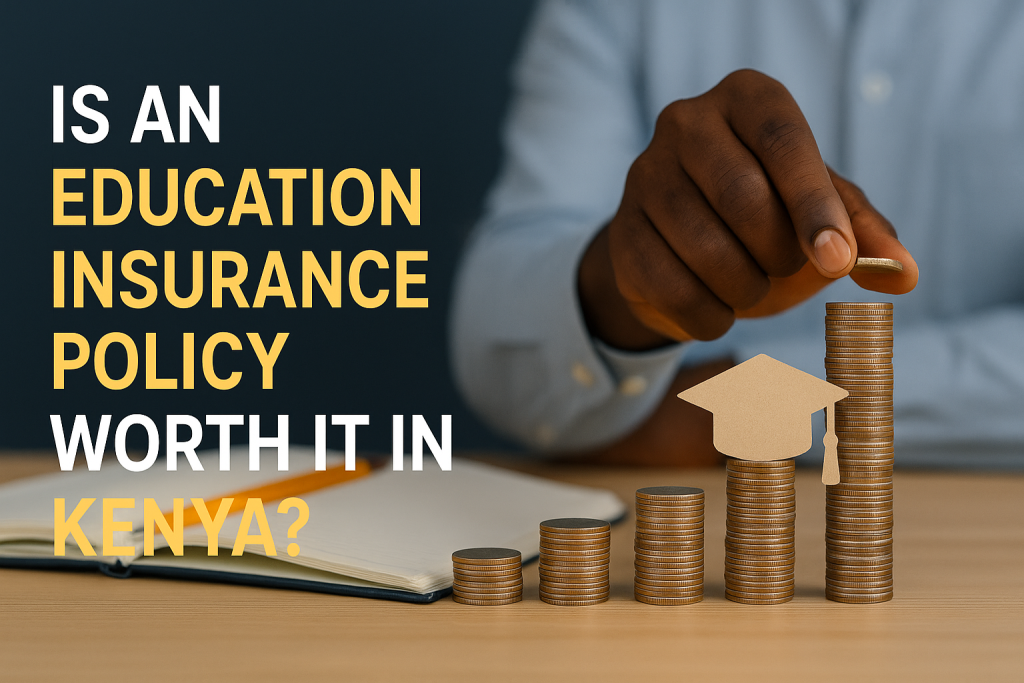
As the cost of quality education keeps rising in Kenya, parents and guardians increasingly ask: “How can I secure my child’s educational future?” One of the popular solutions offered by insurance companies is the education insurance policy—a hybrid product that combines life insurance with a savings plan designed to pay for a child’s education.
But is it truly worth it for Kenyan families? This guide explores what education insurance policies are, how they work, their benefits and drawbacks, and how they compare with other investment options.
What Is an Education Insurance Policy?
An education insurance policy, sometimes called an education plan or child education cover, is a contract between you (the parent or guardian) and an insurance company. You pay regular premiums for a set number of years, and in return, the insurer guarantees a lump-sum payment—or several payouts—when your child reaches specific milestones such as joining secondary school or university.
These policies typically include a life insurance component that protects your child’s education in case you, the policyholder, die or become permanently disabled. If that happens, the insurer waives future premiums and ensures the child still receives the promised benefits.
Education insurance policies in Kenya often come with:
- A fixed saving period (usually 10–18 years).
- A guaranteed payout when the policy matures.
- Bonus or interest earnings depending on the insurer’s performance.
- Life or disability cover for the parent.
- Tax relief benefits (up to a certain amount).
Essentially, it’s a disciplined way to save for your child’s education while securing their future even if you’re no longer around.
How Education Insurance Policies Work in Kenya
In Kenya, most major insurance companies and banks through bancassurance channels offer education insurance policies. They target parents with children as young as one year old, encouraging early savings.
Here’s a general breakdown of how they work:
- Premiums: You choose how much to contribute monthly, quarterly, or annually.
- Term: You select the duration (for example, 10, 12, or 15 years).
- Maturity Value: The insurer projects a payout at the end of the policy term, often including bonuses or profit-sharing.
- Life Cover: If you die or become disabled, the insurer continues paying premiums and ensures your child receives the full benefit.
- Payout Options: Some plans provide annual payments during the last few years (to cover school fees), while others pay a lump sum when the child joins university.
These policies are regulated by the Insurance Regulatory Authority (IRA), ensuring that providers adhere to industry standards. However, the actual returns, flexibility, and transparency vary widely across insurers.
Why Parents Choose Education Insurance Policies
Education insurance policies are appealing for several reasons:
1. Goal-Oriented Savings Discipline
Many parents struggle with consistent savings. An insurance policy enforces financial discipline by requiring fixed, regular contributions toward a defined goal—your child’s education.
2. Protection in Case of Death or Disability
Unlike normal savings accounts, these policies guarantee your child’s education continues even if you pass away or can no longer work. The insurer takes over the premiums and ensures the full benefit is paid.
3. Structured Payouts
Most education plans provide structured disbursements that align with your child’s education milestones, making it easier to manage school fees at different stages.
4. Peace of Mind
Knowing your child’s future education is financially secure provides emotional relief and long-term confidence, especially with rising school fees.
5. Tax Relief Benefits
Some education insurance policies qualify for tax relief on premiums (usually up to KSh 5,000 per month), which slightly reduces the total cost.
The Downsides of Education Insurance Policies in Kenya
While the concept is appealing, education insurance policies also have several drawbacks you should understand before signing up.
A. Low Returns on Investment
Education policies are conservative by design. The majority of your premiums go toward insurance coverage and administrative costs, leaving only a portion to earn interest. As a result, the final payout often barely exceeds the total premiums you paid.
If your goal is to grow wealth, a standalone investment in mutual funds or money market funds will likely offer better returns.
B. Inflexibility and Lock-In Periods
These policies often run for 10–20 years, and early withdrawals attract heavy penalties. Missing several premium payments can cause the policy to lapse, resulting in financial losses. This rigidity can be problematic for parents with unstable income or changing financial priorities.
C. Mixing Insurance and Investment
Critics argue that combining insurance and savings weakens both functions. You may pay higher premiums for limited life cover, while your investment component grows slower than traditional savings plans or market-based investments.
A more efficient alternative is to buy a separate life insurance policy and invest independently.
D. Hidden Costs and Complex Terms
Most education insurance plans include administration fees, commissions, and surrender penalties. Unfortunately, these costs are not always clearly explained during sign-up. Many parents later discover that early termination yields far less than they contributed.
E. Inflation Risk
Education costs in Kenya have been rising faster than average inflation—especially in private and international schools. A policy that pays out a fixed sum may fail to cover future tuition fees adequately.
F. Limited Transparency and Overly Optimistic Projections
Insurance agents often present optimistic payout illustrations that assume perfect conditions. In reality, bonuses and interest rates fluctuate depending on the insurer’s investment performance. Always ask for realistic, conservative projections before signing up.
Is an Education Insurance Policy Worth It?
Whether an education insurance policy is “worth it” depends entirely on your financial situation, goals, and discipline.
It May Be Worth It If:
- You need a structured, enforced savings plan to stay consistent.
- You want life insurance protection bundled with education funding.
- You prefer predictability and peace of mind over high investment returns.
- You can comfortably commit to long-term premiums without risking default.
- Your child’s education goals are moderate (local private or public universities).
It May Not Be Worth It If:
- You already have a life insurance cover and just need a place to grow your savings.
- You prefer flexibility and access to your funds.
- You have a high-risk tolerance and want stronger investment returns.
- Your financial situation might change, making long-term commitments risky.
- You want full control over your savings and investment decisions.
Comparing Education Insurance to Alternative Options
| Option | Description | Pros | Cons |
|---|---|---|---|
| Education Insurance Policy | Combines life cover with long-term savings for education | Peace of mind, protection, disciplined saving | Low returns, lock-in, complex |
| Money Market Fund / Unit Trust | Professional investment in short-term assets | Higher returns, liquidity, flexibility | No insurance cover |
| Separate Life Cover + Investment Account | Term insurance plus self-directed savings plan | Flexible, better control, potential for higher growth | Requires discipline |
| SACCO or Goal Savings Account | Cooperative-based savings with dividends | Easy access, community-based, decent returns | No premium waiver, no life cover |
| Fixed Deposit Account | Bank savings with fixed interest rate | Low risk, predictable | Returns often lower than inflation |
What Experts and Financial Writers in Kenya Say
Financial experts in Kenya are divided. Some believe these policies are helpful for risk-averse parents who struggle with saving discipline. Others view them as outdated, low-return products.
Common criticisms include:
- The returns are too low to outpace education inflation.
- The policy structure benefits insurers more than customers.
- Flexibility is poor, making it difficult to adjust contributions or withdraw funds.
- Many people misunderstand the product, thinking it’s a pure investment.
However, insurance companies emphasize that the real value lies in security and consistency, not speculative profit. For families seeking guaranteed protection and discipline rather than market exposure, these policies can serve a useful role.
Key Questions to Ask Before Buying an Education Insurance Policy
Before you commit, make sure you understand every detail of the policy by asking the following:
- What is the total amount I will contribute over the policy term?
- What is the projected maturity value, and how is it calculated?
- What are the fees, commissions, or administrative costs?
- What happens if I miss premiums or need to withdraw early?
- What benefits apply upon death or disability?
- Are bonuses guaranteed or discretionary?
- How will inflation affect the maturity value?
- What are the exclusions or fine print in the life cover?
- Can I top up, pause, or adjust premiums if my income changes?
- How has the insurer’s past performance compared to its projections?
If the salesperson cannot answer these questions transparently, that’s a red flag.
Practical Tips for Kenyan Parents
1. Start Early
The earlier you begin, the lower your monthly premiums. Starting when your child is very young spreads the cost and compounds growth.
2. Compare Multiple Providers
Get at least three quotations from different insurers. Compare their projected returns, payout structures, and additional benefits.
3. Check IRA Registration
Ensure the insurer is registered and regulated by the Insurance Regulatory Authority (IRA) to protect yourself from fraud or mismanagement.
4. Be Realistic About Returns
Do not expect huge profits. Treat it as a disciplined savings plan with a safety net, not an aggressive investment.
5. Keep a Backup Investment
Even with a policy in place, maintain additional savings or investments (like a money market fund) to cushion against rising education costs.
6. Read the Fine Print
Many parents sign up based on brochures or agent explanations without reading the contract. Take time to understand all terms.
7. Avoid Over-Commitment
Choose a premium that fits comfortably within your long-term budget. Missing payments can reduce or void your benefits.
8. Reassess Periodically
Review the policy every year to ensure it still meets your goals, especially if your child’s educational path or your financial situation changes.
A Sample Scenario
Imagine you start an education policy when your child is five years old. You pay KSh 5,000 monthly for 15 years—totaling KSh 900,000 in premiums. The insurer projects a payout of KSh 1.3 million when your child turns 20.
On paper, that looks decent. But if education inflation averages 7–10% annually, by the time your child reaches university age, KSh 1.3 million may not cover tuition and living expenses.
If instead you invested KSh 5,000 monthly in a money market fund with an average annual return of 9%, you could end up with more than KSh 1.5 million—without the insurance protection but with higher liquidity.
That example highlights the core trade-off: security and discipline vs flexibility and growth.
Key Takeaways
- Education insurance policies in Kenya combine life insurance and long-term savings aimed at covering education costs.
- They offer peace of mind, protection, and financial discipline.
- However, they typically yield low returns, involve long lock-in periods, and are less flexible than pure investment options.
- Whether it’s “worth it” depends on your financial goals, discipline, and comfort with risk.
- Always compare policies, read the fine print, and consider pairing insurance with other investment strategies for a balanced approach.
Final Verdict
So, is an education insurance policy worth it in Kenya?
Yes—if you value the combination of savings and life protection, desire structure, and can maintain long-term premiums without interruption. It provides a safety net that ensures your child’s education even in your absence.
No—if your main objective is to maximize returns, maintain flexibility, or you already have sufficient life cover. In that case, you may achieve better results by separating your insurance and investment plans.
Ultimately, education insurance is neither a scam nor a magic bullet. It’s simply a financial tool—useful for some, unsuitable for others. The smart parent is the one who understands both the benefits and the trade-offs, and makes an informed decision based on personal goals and realistic expectations.
Frequently Asked Questions (FAQs) About Education Insurance Policies in Kenya
1. What exactly is an education insurance policy in Kenya?
An education insurance policy is a long-term plan that combines savings and life insurance. It allows parents to save money toward their children’s future education while ensuring that, in the event of the parent’s death or permanent disability, the insurer continues to pay the premiums or pays the full benefit to the child. Essentially, it is both a protection and a savings product. The policy matures after a set period, usually between 10 and 20 years, and pays a lump sum or periodic payouts to cover school or university fees.
2. How does an education insurance policy differ from ordinary savings accounts?
The biggest difference is that an education insurance policy includes a life cover, whereas an ordinary savings or investment account does not. With an education policy, your child is guaranteed to receive the funds even if something happens to you. Traditional savings accounts or SACCO deposits may offer more flexibility and higher returns, but they provide no insurance protection. In short, education insurance gives peace of mind, while savings accounts give liquidity and higher growth potential.
3. Which companies in Kenya offer education insurance policies?
Many licensed insurers provide these products. Among the most common are ICEA Lion, CIC Life, Jubilee Life Insurance, Britam, Sanlam, Madison, and Equity Life Assurance. Most major banks in Kenya also partner with these insurers through bancassurance, allowing customers to buy education plans directly at the bank. Each company has unique terms, so it’s important to compare policy duration, bonuses, payout options, and premium amounts before committing.
4. What are the typical returns or benefits I can expect?
Returns vary depending on the insurer’s investment performance and the type of policy. However, education insurance policies in Kenya generally yield conservative returns—often around 4% to 6% annually—after factoring in bonuses and guaranteed amounts. The main benefit is not high returns but guaranteed payment and life protection. If your goal is aggressive growth, you might want to consider other investment vehicles like unit trusts, mutual funds, or money market funds.
5. What happens if I miss premium payments or stop contributing?
Most policies allow a short “grace period” of 30 to 90 days to make up missed payments. If you exceed this period, the policy may lapse, meaning your coverage and investment benefits are suspended or lost. Some insurers offer a reduced “paid-up” value—essentially freezing the policy with a smaller maturity amount. Before signing, always confirm how your provider handles missed payments or early surrender, as penalties can be significant.
6. Are education insurance policies in Kenya regulated or safe?
Yes. These policies are regulated by the Insurance Regulatory Authority (IRA), which oversees all licensed insurance companies in Kenya. The IRA ensures that insurers follow strict financial guidelines and maintain adequate reserves to meet future obligations. However, the safety of your returns also depends on the insurer’s stability and investment performance, so it’s wise to choose reputable, long-standing companies with strong financial ratings.
7. Can I have more than one education insurance policy?
Yes. Some parents take multiple policies for different children or different education stages. For instance, you can have one policy that matures when your child joins high school and another for university. Having multiple policies helps spread the risk and ensures that each child’s education is adequately funded. Just make sure your combined premiums fit comfortably within your monthly budget.
8. What are the common mistakes parents make when buying education insurance?
Common mistakes include:
- Failing to read the policy document carefully.
- Overestimating future payouts based on optimistic sales projections.
- Buying a policy that exceeds their financial capacity.
- Confusing the policy with a high-yield investment.
- Ignoring inflation and future school fee increases.
Always base your decision on verified numbers, not just the salesperson’s presentation. Ask for clear illustrations showing total contributions, maturity values, and projected returns.
9. Is it better to buy a separate life cover and save elsewhere?
Many financial experts believe that separating life insurance from savings is more efficient. A term life policy offers higher coverage at a lower premium, while independent investments like money market funds, SACCOs, or mutual funds yield better returns. However, education insurance policies appeal to parents who want convenience and don’t have the discipline to save consistently. The best choice depends on your personality, income stability, and long-term financial goals.
10. Do education insurance policies cover international education?
Most policies in Kenya are structured around local education costs, but some allow you to use the maturity payout for international education as long as the funds are paid to you directly. However, the coverage amount may not be enough to meet foreign tuition fees, which are much higher. If you’re targeting international schooling, consider topping up your education plan with additional investments in foreign currency or global mutual funds.
11. How can I calculate the right amount to save for my child’s education?
Start by estimating how much your preferred school or university charges today. Then apply an average inflation rate of 8–10% per year to project future costs. For example, if tuition currently costs KSh 500,000 annually, in 10 years it might cost close to KSh 1 million. Use this estimate to determine how much you need to save monthly to meet that target. Some insurance companies provide online calculators to help with this, but you can also work with a financial planner.
12. What are the tax benefits of education insurance policies?
In Kenya, life insurance policies—including education covers—may qualify for tax relief of up to 15% of the premium paid, capped at KSh 60,000 per year. This effectively reduces your total tax liability. However, you should confirm with the Kenya Revenue Authority (KRA) or your insurer to ensure your specific policy qualifies, as tax laws and limits can change over time.
13. Can I borrow against my education policy?
Some insurers allow you to borrow a portion of your policy’s “cash value” after a certain period, usually three years. This feature can help during emergencies or temporary financial shortfalls. However, borrowing reduces the maturity value and may attract interest until the loan is repaid. Use this option cautiously, and only if it won’t compromise your child’s education fund in the long term.
14. What should I check before signing an education insurance policy?
Before you sign:
- Read the full policy document, not just the brochure.
- Verify the insurer’s IRA registration.
- Understand all charges, bonuses, and penalties.
- Confirm premium waiver benefits on death or disability.
- Compare with at least two other providers.
- Ensure the maturity value aligns with your child’s education needs.
Doing due diligence prevents disappointment later when you realize your returns or benefits are lower than expected.
15. What is the best alternative to education insurance in Kenya?
If your main goal is capital growth, alternatives such as money market funds, unit trusts, Treasury bills, SACCO savings, or long-term investment plans can deliver higher returns. These options offer more liquidity and flexibility, allowing you to withdraw or adjust contributions easily. Pairing these with a low-cost life insurance plan provides similar protection at a lower overall cost.