For decades, the path to wealth for the average Kenyan was predictable: buy a piece of land, build “mabati” houses or rentals, and perhaps buy shares in Safaricom or a few Tier-1 banks. While these traditional investments have served many well, the economic landscape of 2025 has introduced new challenges.
With the volatility of the Kenyan Shilling (KES) and a local stock market that often lacks sector diversity, many Kenyans are asking: “How can I own a piece of the world’s biggest companies?”
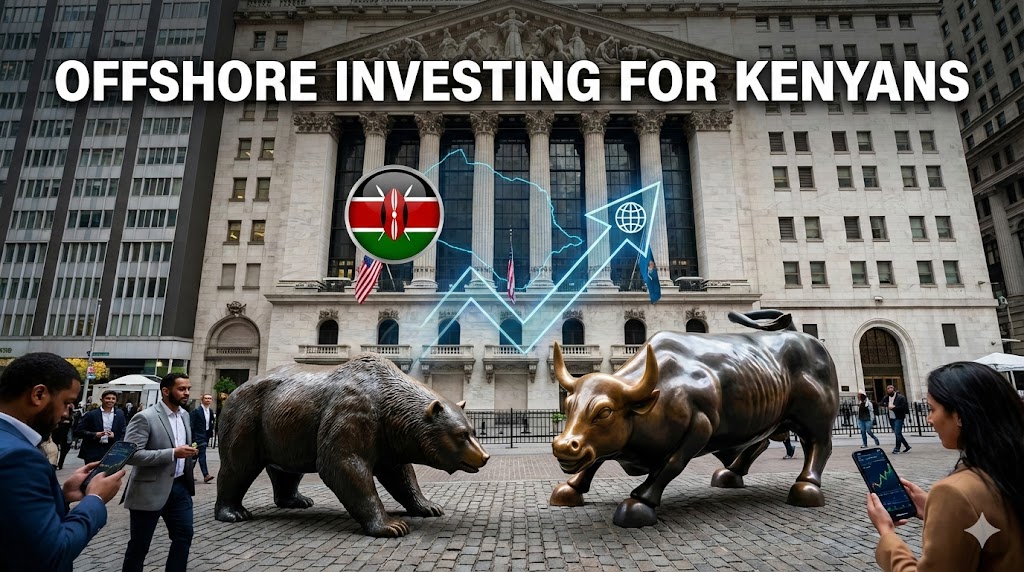
The good news is that the barriers to entry have crumbled. You no longer need millions of shillings or a Swiss bank account to invest in the New York Stock Exchange (NYSE) or the NASDAQ. Whether you are a Gen Z freelancer in Eldoret or a corporate professional in Upper Hill, global markets are now just a few taps away.
Why Every Kenyan Portfolio Needs Offshore Exposure
Before we dive into the mechanics, it is essential to understand the strategic importance of “going global.” Investing offshore is not about “abandoning” Kenya; it is about smart diversification.
1. Hedging Against Currency Depreciation
The Kenyan Shilling has historically faced pressure against the US Dollar. When you invest in US stocks, you are holding assets priced in USD. If the Shilling weakens, your investment automatically gains value in local terms. For a Kenyan investor, this acts as a natural insurance policy for your purchasing power.
2. Accessing Innovation
The Nairobi Securities Exchange (NSE) is heavily concentrated in finance, telecommunications, and agriculture. While these are vital, the NSE does not offer direct exposure to the world’s fastest-growing sectors, such as:
- Artificial Intelligence (AI): Companies like Nvidia and Microsoft.
- Electric Vehicles (EVs): Giants like Tesla or BYD.
- Global E-commerce: Amazon, Alibaba, and MercadoLibre.
- Biotechnology: Revolutionary healthcare firms.
3. Historical Performance and Stability
While all markets have risks, the S&P 500 (an index of the 500 largest US companies) has delivered an average annual return of approximately 10% over the last several decades. This level of consistency, backed by the depth of the US economy, provides a stable foundation for long-term wealth building.
The Gateway: How to Choose a Broker
In the past, Kenyans had to fill out endless paperwork and send expensive wire transfers to international banks. Today, you have two primary routes: local licensed apps and global discount brokers.
Option A: Local CMA-Licensed Platforms
These are Kenyan-founded or Kenyan-regulated fintech companies that act as intermediaries. They are the easiest starting point for beginners.
- Ndovu: A regulated wealth management platform that uses “Robo-advisors” to help you pick a portfolio based on your risk appetite. They offer fractional shares, meaning you can invest as little as KES 1,000 to own a tiny portion of a high-priced stock like Berkshire Hathaway.
- Hisa: A social investing app that makes the US market feel like a social network. You can follow other investors, see their trades, and buy US stocks and ETFs directly from your phone.
- Standard Investment Bank (SIB) – Mansa: If you prefer a “hands-off” approach, SIB’s Mansa Fund provides a managed global portfolio where professional fund managers handle the stock picking for you.
Option B: International Discount Brokers
For the more experienced investor who wants lower fees and access to global markets like London, Tokyo, or Hong Kong, international brokers are the better choice.
- Interactive Brokers (IBKR): Frequently ranked as the best for international investors. They have no minimum deposit and offer professional-grade tools.
- Saxo Bank: A more premium option, ideal for high-net-worth individuals who require deep research and a wider range of asset classes.
The Practical Steps: Moving Your Money
The biggest hurdle for Kenyans is often the logistics of funding an offshore account. Here is the step-by-step process:
- Documentation: You will need your KRA PIN, a clear photo of your National ID or Passport, and a recent bank statement or utility bill (not more than 3 months old) to prove your residence.
- Account Opening: This is usually done entirely online. Local apps take about 24 hours to verify, while international brokers might take 2–5 business days.
- Funding (The Critical Step): * M-Pesa: Most local apps like Ndovu and Hisa allow M-Pesa deposits. They convert your KES to USD at an internal exchange rate.
- Bank Transfers (SWIFT): If using an international broker like IBKR, you can send USD from a local USD-denominated bank account.
- Digital Wallets: Many Kenyans use services like Wise to bridge the gap between their Kenyan bank and global brokers, as Wise often offers much better exchange rates than traditional commercial banks.
Comparison of Investment Approaches
| Feature | Local Apps (Ndovu/Hisa) | International Brokers (IBKR) |
| Ease of Use | Very High (Mobile-first) | Medium (Complex interface) |
| Minimum Deposit | Very Low (e.g., KES 1,000) | $0 (but wire fees apply) |
| Funding Method | M-Pesa, Local Bank | SWIFT, Wise |
| Regulation | CMA (Kenya) | SEC/FINRA (USA), FCA (UK) |
| Asset Variety | US Stocks & ETFs | Global Stocks, Options, Bonds |
Understanding Taxes: What Does the KRA Want?
Taxation is a vital consideration. When you invest in the US, you are subject to two types of taxes:
1. Dividend Withholding Tax
If a US company you own (like Coca-Cola) pays a dividend, the US government automatically deducts 30% of that dividend before it hits your account. Since Kenya does not have a specific Double Taxation Agreement with the US for individual stock investors, this 30% is a standard cost of doing business.
2. Capital Gains Tax (CGT)
In Kenya, Capital Gains Tax is currently 15% on the gain made from the transfer of property. However, the taxation of offshore stock gains can be complex. Generally, Kenya taxes income “accrued in or derived from Kenya.” However, as a tax resident, if you bring that money back into the country, it may be subject to scrutiny. It is highly recommended to keep a clear ledger of your investments and consult a tax professional annually.
The “Start Small” Strategy
If the thought of picking individual stocks like Apple or Amazon feels overwhelming, don’t worry. Most successful investors don’t pick individual stocks—they buy ETFs (Exchange Traded Funds).
An ETF is a basket of hundreds of companies. For example, buying the Vanguard S&P 500 ETF (Ticker: VOO) means you are instantly buying a small piece of the 500 largest companies in America. If one company fails, the other 499 carry the weight. This is the safest way for a Kenyan beginner to build long-term wealth.
Final Thoughts: The Risks to Manage
Offshore investing is not a “get rich quick” scheme. You must be prepared for:
- Market Volatility: Global markets can drop 10–20% in a single month due to global events. You need a “long-term” mindset (5–10 years).
- Platform Safety: Only use platforms that are regulated. If an “investment company” on WhatsApp promises 50% monthly returns on US stocks, it is a scam.
- The Time Gap: The US market opens at 4:30 PM Kenyan time. While you can place trades anytime, the “action” happens in our evening.
Investing offshore is about giving your future self the advantage of a global economy. Start small, be consistent, and watch your “Kenyan-earned” money grow on a global scale.
Frequently Asked Questions: Offshore Investing for Kenyans
1. Is it legal for a Kenyan to buy US stocks?
Yes, it is perfectly legal. The Capital Markets Authority (CMA) has established a framework for regulated intermediaries to provide these services. While you are free to use international platforms, you must ensure you comply with the Central Bank of Kenya (CBK) guidelines regarding the transfer of large sums of money abroad (the “USD 10,000 rule”).
2. Can I invest with very little money?
Yes. Thanks to fractional shares, you no longer need the full price of a stock (which could be hundreds or thousands of dollars). Platforms like Ndovu and Hisa allow you to buy $10 worth of Apple or Nvidia.
3. What is an ETF and why should I start there?
An ETF (Exchange Traded Fund) is a “basket” of stocks. Instead of gambling on one company, you buy a fund like the Vanguard S&P 500 (VOO) which owns the 500 largest US companies. This reduces your risk significantly; if one company performs poorly, the others offset the loss.
4. How long does it take to withdraw my money?
Withdrawals typically take 3 to 5 business days. The funds must first be settled in the US (which usually takes two days after you sell the stock) and then wired back to your Kenyan bank or M-Pesa.
5. What are the “hidden” costs?
Beyond the broker’s commission, be mindful of:
- Currency Conversion: Banks and apps often charge a 1%–3% “spread” when converting KES to USD.
- Withdrawal Fees: International wires can cost between $15 and $30 per transaction.
- Inactivity Fees: Some premium brokers charge a monthly fee if you do not trade frequently.
6. Are my investments safe if the platform shuts down?
If you use a US-regulated broker, your assets are typically protected by the SIPC for up to $500,000. Even if the broker goes bankrupt, your shares are held in “custody” and can be moved to another broker. Always verify that your chosen platform has this protection.
7. Does the KRA know about my offshore investments?
Under the Common Reporting Standard (CRS) and recent 2025 KRA enforcement drives, tax authorities are increasingly sharing data globally. It is always better to be transparent and declare your foreign income to avoid heavy penalties and interest.